Elmo Library › Reverse Collapse: Code Name Bakery 逆向坍塌:面包房行动 › Side stories
Classified Secret Files
机密文件档案(共29卷)
30 chapters · 894 lines · each chapter's full English and Chinese script is on its own page. Japanese and Korean, voices and theatre mode are in the reader.
Open in the Elmo Library readerChapters
- Monthly Magazine Archive: Latest Zone Definitions
- Dolls Rights Related Manuscript
- Summary of the Antarctic War Situation
- The Establishment and History of the Rescue Foundation
- Application of Doll Technology in the late 90s
- Codename "Operation Bakery" Briefing
- Phone Log 7:03
- Codename "Operation Bakery" Operational Report
- "Paradeus" Investigation Files
- Inner Caucasus Theater Deployment Instructions
- NSC-68
- Warszawa Incident Files
- Antarctic Union Technological Achievements
- Surveillance Records
- CP57 Files
- Antarctic Union's Genetics Breeding Technology Investigation Reports
- Radiation Sickness Treatment Report
- Records of the "GAVIRUL" Experiment
- Audio Record of June 19th – June 25th, 2030
- Introduction to Collapse and Reverse-Collapse Technologies
- AD 1945 – AD 1981, the Age of Relics
- Research on Modern Relics
- GAVIRUL Reproduction Project
- Servant
- First Beilan Island Incident
- The Third World War and Antarctic Independence
- Establishment of the Antarctic Union and the First Antarctican War
- Eurosky Low-Emission Infectious Disease
- GAVIRUL Project
- Tactics Guide & Reference
Monthly Magazine Archive: Latest Zone Definitions 月刊档案 - 最新区域定义
[Transcript of Zone Difinitions][区域定义副本]
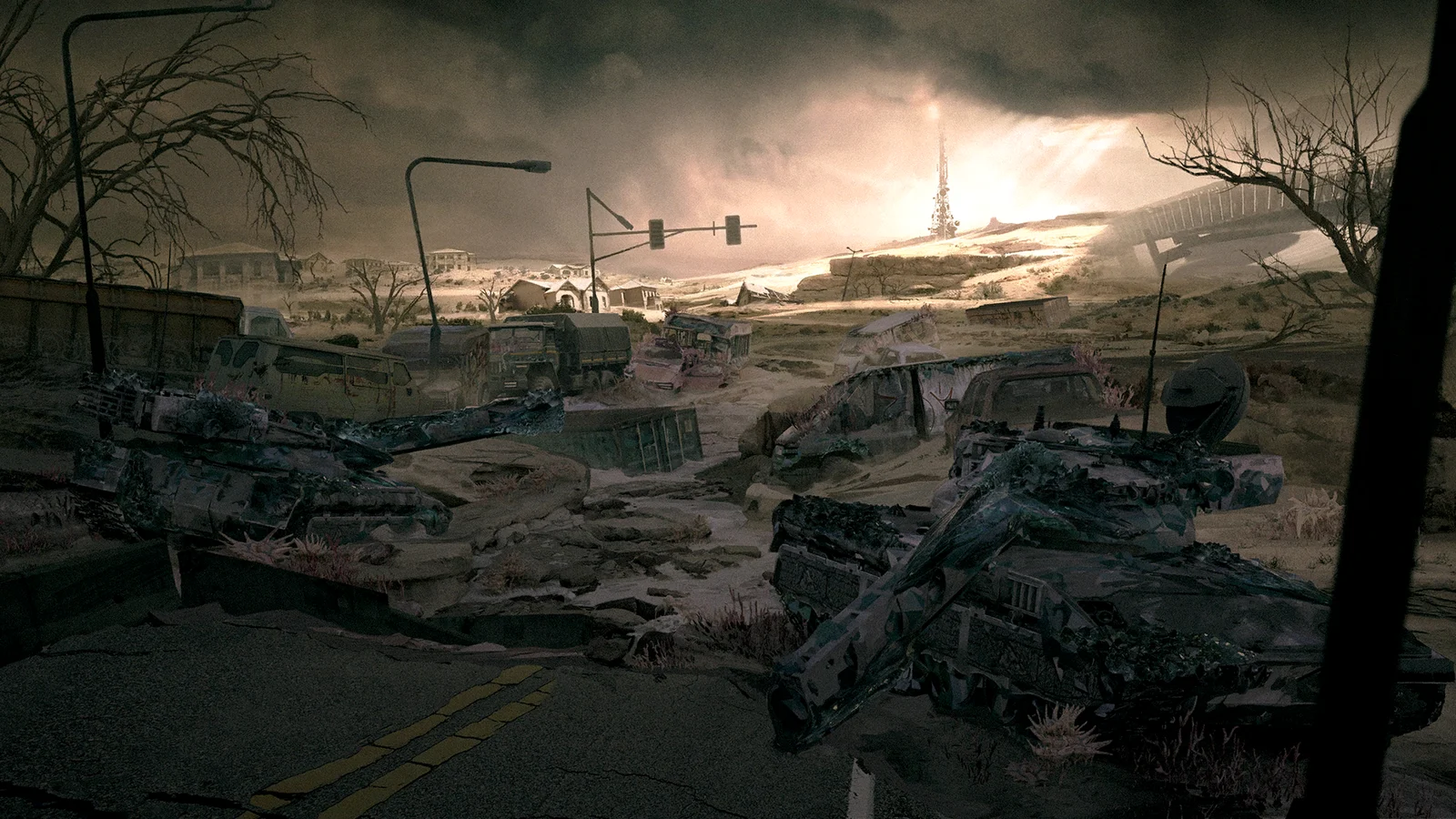
"Heavy Contamination Zones, Contamination Zones, and Safe Zones" Rossartrist Monthly, February 2089 Red Zones Red Zones are heavily contaminated areas defined by the United Nations as lethally hazardous to living organisms. The intensity of Collapse radiation in these regions is harmful to both living organisms and ordinary electronics. Special protective procedures are required for both humans and machinery before they can enter Red Zones. After the Beilan Island Incident, Red Zones have become a breeding ground for ELIDs. Collapse radiation storms have ravaged regions covered in nature, crystallizing and silicifying the flora into crystalized forests. It has also given birth to a new species of plant that is adapted to Collapse radiation—dense clumps of radioactive Epiphyllums. They periodically absorb and release Collapse radiation particles, rapidly converting passing lifeforms into ELID creatures. The surviving ELID-infected individuals have evolved different traits to adapt to their environment —there are predators that spew acidic fluids, large beasts with silicified hides, and so on. Among them, the most powerful known to men are Type D ELIDs, which must be suppressed with the use of Assault Artillery units. Red Zones are utterly uninhabitable by human beings. In fact, studies to date have not managed to find any signs of large-scale inhabitation of Red Zones by any lifeforms. Most of the human structures in the Red Zones that are still standing have been built before the Beilan Island Incident. The structures that have not been restored and reused are now in ruins due to the Collapse radiation storms and extreme climate. Given that they might collapse and crumble at any time, it is safe to say that any value there may have been in recovering them have been lost. The frequent Collapse storms in the Red Zones have removed surface water bodies, topsoil, and the water tables there, turning them into deserts. Certain areas which were rich in organic matter have been silicified by the Collapse radiation and appear as masses of black rock. Yellow Zones Strictly speaking, Yellow Zones should be referred to as "contamination zones". After 2030, the United Nations used low-orbit detection satellites to map the intensity of Collapse radiation on the Earth's surface. Such areas are classified as contamination-free zones, contamination zones and heavy contamination zones. They are also more commonly known as Green Zones, Yellow Zones, and Red Zones. After the Beilan Island Incident, contamination zones were considered unsuitable for human habitation. However, human attitudes towards contamination zones gradually changed after the onset of the Northern Lights Incident in 2035. Since Europe's Green Zones cannot accommodate all of the Yellow Zone refugees, some 80 million people were stranded in Yellow Zones along the coastlines of Central, Eastern and Western Europe. EU authorities expected a devastating outbreak of ELID, but the number of ELID sightings were much lower than expected. After dozens of low-flying aerial reconnaissance missions in the contamination zones, EU authorities found that the Collapse radiation levels in the contamination zones permitted settlement by humans. A common layout for settlements in less built-up Yellow Zones is as follows: solar panels are erected on the edge of the settlement that has the highest Collapse radiation. This power is run through transformers and substations before being sent out to the residential areas, which have lower radiation levels. Most structures within the residential area are made of reinforced concrete and they are ready for human habitation once their windows and pipes have been given a simple anti-Collapse radiation coating. These buildings are connected by sky bridges that are protected from Collapse radiation. From a distance, such Yellow Zone settlements look like villages on stilts. If a Yellow Zone settlement is lucky enough to be located near an unpolluted field or lake, a small settlement of ten or more people will have access to several hectares of clean land. This settlement can then become fully self-sufficient by growing potatoes and other easily-cultivated vegetables. The vast majority of Yellow Zone settlements in the wilderness have a population of fewer than 100 people. On the other hand, old cities that have been converted into large settlements present a completely different scene; buildings line the streets while anti-radiation installations and solar panels cover most of the settlement like an awning, giving most residents no chance to see the sky. Green Zones Green Zones are divided into primary Green Zones and non-primary Green Zones. Primary Green Zones are dominated by vegetation and are only slightly contaminated by radiation, but their status is not sufficient for the government to invest the large amount of resources needed to administer them as White Zones. Non-primary Green Zones refer to contamination zones that can be settled normally after contamination levels are reduced through the course of decontamination works. Such regions are the main fruits of the implementation of the European Collapse Radiation Contamination Zone Restoration and Revitalization Joint Development Agreement. For those Green Zones adjoining White Zones, the fixed quarantine walls outside the White Zone will be removed once the Collapse radiation levels of a Green Zone have been reduced to a point where it becomes viable for municipal planning and construction, and the Green Zone will be gradually integrated into the White Zone, in theory. Of course, this is only a vision and hope. In practice, non-primary Green Zones can be divided into the following four categories: residential and entertainment districts, satellite cities which are constructed depending on the size of the urban area of the White Zone, industrial and agricultural regions to meet the needs of various regions, and open regions to be developed later. Residents of a Green Zone often work in a White Zone's service industry. As such, the Green Zone's streets are deserted by day but come alive at night. Green and White Zones are connected by express rail routes, which travel on closed loops over suspended rail bridges. Said routes go from a terminal in a particular satellite city to one or several stops inside the White Zone. Due to the fact that the Purification Project is still in progress, the number of Green Zones that can be used is relatively small, and the number of people they can support is relatively limited. Overall, entering a Green Zone from a contamination zone and settling there requires strict identification checks. White Zones The concept of White Zones emerged after the establishment of the URNC in the 2070s. They are not so much areas free from Collapse radiation as areas with political stability and good social order. These former global political and economic centers are completely insulated from Collapse radiation by massive quarantine walls and purification towers and have well-trained police and social services to keep residents safe. Newly opened air routes and an extensive intercontinental train network connects every urban hub on the continent that has been classified as "white". They are the few remaining jewels of human civilization after the Beilan Island Incident. Due to the shortage of unpolluted land and population migration policies, most municipal planning in White Zones is vertically oriented, with the complex and highly developed three-dimensional public transportation network serving as a unique feature of the White Zones. The vast array of skyscrapers and underground spaces extending tens of meters underground constitute a bustling three-dimensional urban cluster; almost every single building therein is connected to an elevated interchange or vehicle lifting system. Due to the shortage of land, there is a general lack of greenery and parks in White Zone cities, and the few green belts that remain are used as buffer zones between the quarantine walls and urban areas. In the event the quarantine wall falls, the unobstructed open space can allow the garrison troops to buy time for citizens to evacuate. Security in the White Zones is nominally the responsibility of URNC garrison troops. City authorities also organize a system of police/special police forces under their command, and some even hire PMCs for extra protection. Most White Zone cities have large-scale defensive earthworks and security systems to cope with terrorist attacks and Collapse storms. Every year, White Zone cities hold a defense drill for all their residents. Such exercises usually cover scenarios where the quarantine wall has fallen, leading to an incursion of ELID creatures. In recent years, there has also been an emerging practice of conducting full-on military maneuver exercises. In general, the combination of these two security forces and the PMCs means that the crime rate in the White Zones is extremely low, and organized violent crime is virtually non-existent.《重污染区,污染区和安全区》 罗克萨特主义月刊,2089年02月 红区 红区,联合国定义中对于生物有绝对危害性的重污染区,其地表坍塌辐射强度对于生物和一般电气部件是有害的,不论人类还是机械都需要进行特殊的防护处理后才能在红区内行动。 北兰岛事件后,红区成为了滋养ELID-Infected的温床。曾经的植被地区经过坍塌辐射风暴洗礼,晶化和硅化的植物形成了新的水晶森林,并诞生了适应坍塌辐射的新物种——分布密集的辐射昙花。它们会周期性地吞吐坍塌辐射粒子,将路过的生物加速ELID化。而那些为了适应环境而幸存下来的ELID-Infected则进化出了各自不同的性状——喷涂酸液的特殊捕食者、身披硅化外皮的巨兽,还有只能动用强铳兵才能压制、人类目前已知最强大的D型ELID-Infected。 红区中不存在人类生存的可能性,现今为止的研究甚至没有发现成规模生物在红区生存的证据。红区内现在仍可辨识的人类建筑基本都建于北兰岛事件前,其中未经再利用处理的建筑物如今也都因坍塌辐射风暴和极端气候而变得破烂不堪,随时都可能倒塌并粉末化,可以认为已经失去了恢复价值。而红区内频繁的坍塌风暴造成地表水体、腐殖质和土地中的水分流失,使其土地呈现出沙漠化的景象。部分有机物丰富的地区则在坍塌辐射照射下硅化,呈现出黑色岩体的外观。 黄区 黄区,准确来说应该称其为“污染区”。2030年后,联合国利用低轨探测卫星对地面进行坍塌辐射强度探测,并根据探测到的各地平均坍塌辐射强度,划分了非污染区、污染区和重污染区,也就是我们俗称的绿区、黄区和红区。 北兰岛事件后,污染区一度被视作不合宜人类居住的地区。然而,2035年北极光事件爆发后,人类对待污染区的态度逐渐出现了变化。由于欧洲的绿区并不能收容所有的黄区难民,大约有八千万人口滞留于中欧,东欧和西欧海岸线的黄区中。欧盟当局本以为会迎来毁灭性的ELID-Infected灾难,但最终ELID-Infected的目击报告远低于预期数值。对污染区进行数十次低空侦查后,欧盟当局发现污染区的坍塌辐射数值是可供人类生存的。 一个常见的野外黄区聚集点往往是这样的:坍塌辐射数值较高的居住区边缘竖立着太阳能坍塌辐射电池板,通过变电箱、变电站进行升压转换后,向坍塌辐射污染较低的居住区供电。居住区内大多数都是钢筋混凝土建筑,对窗户、水管进行简单的坍塌辐射防护后即可供人居住。建筑和建筑之间依靠坍塌辐射防护的天桥长廊连通。从远处看,黄区聚集点像是不接近地面的塔楼式村落。如果黄区定居点幸运地坐落在未被污染的小块田野、湖泊附近,那么十余个人构成的小聚落将坐拥几公顷的干净土地。届时,通过种植土豆和其他易于存活的蔬菜,定居点完全可以做到自给自足。 绝大多数野外的黄区聚集点不会超过一百人,而由过去的旧城市改造成的大型城镇又是另一番景象。依靠着街道两侧的建筑,像雨棚一样的辐射防护装置和发电板覆盖了整座城镇,让居民几乎看不到天空。 绿区 绿区,又分为原生绿区和非原生绿区。原生绿区以植被为主,本身受到的辐射污染比较轻微,但地位不足以令政府投入大量资源将其治理为白区。非原生绿区是指在净化工程推行过程中,污染等级降低,能被正常利用的地区,是《欧洲坍塌辐射污染区恢复及振兴联合开拓协议》推行的核心成果。 实际上,在地区坍塌辐射浓度降低、可进行城市规划建设后,白区外围的固定式隔离墙将会被拆除,绿区将会逐渐转化为白区。当然,这只是一种设想与期待,真正的非原生绿区基本上可以分为以下四类:以居民区及配套娱乐设施为主,根据白区城市规模建立的数量不等的卫星城;给各区域发展提供各种不同需求的工厂区;供给对应白区城市饮食需求的种植地、养殖场;以及待开发区域。 绿区居民多为白区服务业从业者,白日街巷无人,夜晚灯火通明。绿区与白区有专门的轨道列车相连,此类列车行驶于架设在空中的封闭轨道桥上,往返于单个卫星城站点与一个或者几个白区站点间。 因净化工程仍在进行中,目前可被利用的绿区数量较少,可供承载的人类数量比较有限。整体上,从污染区进入绿区并定居需要严格的身份核查。 白区 白区这一概念实际上在70年代罗联建立后才开始出现,与其说是免于坍塌辐射的地区,不如定义为政治稳定、社会秩序安全的区域。这些曾经的世界政治、经济中心借助巨大的隔离墙和净化塔和坍塌辐射彻底隔离,并有着训练有素的警察和社会机构保证居民的安全。发达的洲际列车铁路网和新开辟的空中航线连通大陆上每一个被标记为白区的都市群。这是人类文明在北兰岛事件后仅存的明珠。 由于未污染土地的紧缺和人口迁移政策,白区大多数重视纵向规划,复杂多变又极其发达的公共立体交通网是白区的独有特色。铺天盖地的摩天大楼和深入地下数十米的地下空间构成了繁华的立体都市群,几乎每个建筑都接入了高架立交或车辆升降系统。由于土地紧缺,白区城市内普遍缺乏绿化和公园,极少数的绿化带被用作于隔离墙与城区之间的缓冲带,一旦隔离墙沦陷,毫无遮挡的开阔空间能让卫戍部队为市民争取撤离时间。 白区安全名义上由罗联直属的卫戍部队负责,另外联盟行政机关会组建一套警察-特警系统,甚至还有大量受雇佣的PMC为雇主提供额外安全保障。绝大多数白区城市建有大型的防护工事和安全系统,以应对恐怖袭击和坍塌风暴。每年白区城市都会举行全民参与的防护演习,通常以隔离墙沦陷、ELID攻入为蓝本,近些年也开始定期举行军事演习。总的来说,在双重安保系统和PMC的支持下,白区的犯罪率极低,系统性的暴力犯罪基本不存在。
[Transcript of Zone Difinitions – Illustration][区域定义副本-配图]
Full chapter script (3 lines) →Dolls Rights Related Manuscript 人形权益相关稿件
[Dolls Rights Related Manuscript][人形权益相关稿件]
Target 2085: Advocates for Doll Rights目标2085:为人形的权利呼喊之人
"Liberator 2084-11"《自由解放者 2084-11》
Full chapter script (11 lines) →Summary of the Antarctic War Situation 南极战争事态简述
[Summary of the Antarctic War Situation][南极战争事态简述]
"International Refugee Migration During the First Antarctican War"《第一次南极战争爆发期间的国际难民流向》
Rossartrist Monthly, November 2092罗克萨特主义月刊,2092年11月
Full chapter script (7 lines) →The Establishment and History of the Rescue Foundation 救援组织成立始末
[The Establishment and History of the Rescue Foundation][救援组织成立始末]
"The Global Rescue Foundation"《国际难民援助组织》
Rossartrist Monthly, April 2091罗克萨特主义月刊 2091年04月
Full chapter script (9 lines) →Application of Doll Technology in the late 90s 90年代末人形技术应用
[Application of Doll Technology in the Late 90s][90年代末人形技术应用]
"Applications of Doll Technology in 2092"《2092年人形技术应用》
"Technological Visionaries"《科技前瞻者》
Full chapter script (6 lines) →Codename "Operation Bakery" Briefing 代号“面包房行动”简报
[Codename "Operation Bakery" Briefing][代号“面包房行动”简报]
MID: Operation Bakery – BriefingMID:面包房行动-简报
[Satellite Map][卫星地图]
Full chapter script (17 lines) →Phone Log 7:03 电话记录7:03
[Phone Log 7:03][电话记录7:03]
Colonel Beria, I tried the coffee shop you recommended... [00:01]贝利亚长官,你嘱咐的咖啡店我已经试过了……[00:01]
You sound disgruntled, my friend. [00:08]你听起来有所不满啊,我的朋友。[00:08]
Full chapter script (19 lines) →Codename "Operation Bakery" Operational Report 代号“面包房行动”作战报告
[Codename "Operation Bakery" Operational Report][代号“面包房行动”作战报告]
Verdict结论
Failures in MID's intelligence gathering and influence by specific political objectives led to rash military decision-making, resulting in TASA Team 3 carrying out "Operation Bakery" with insufficient intelligence, limited support, and no specific concept of the mission's purpose.因MID在情报工作上的失误和被特定政治目的所影响导致最终做出莽撞的军事行动判断,致使TASA第三分队在情报不足、支援有限并且对任务目的无具体概念的情况下执行了“面包房行动”。
Full chapter script (7 lines) →"Paradeus" Investigation Files “帕拉蒂斯”调查档案
[Investigation into the Origin of Religions][宗教起源调查]
"The Disintegration of Old Faiths and the Rise of Emerging Religions" Rossartrist Monthly, July 2073 The end has come, but not in the way all the scriptures describe it. The events of Beilan Island in 2030 destroyed not only half the world, but also religious beliefs on a global scale. When the end really came, no one was be able to correctly predict its arrival. There was no salvation, no paradise for refuge. What waited for the believers were the raging ELID and war that swept the globe—it was only a matter of time before those faiths were doomed to collapse. Before the outbreak of World War III in 2045, the United Nations conducted its last census of humanity. According to the report, 75% of the world's population was atheist, another 20% was agnostic, and only 5% still adhered to their religious beliefs. Mass disillusionment towards religious faiths also became fuel for chaos and destruction. Humanity relinquished the concept of self-redemption; people became demons that fought to the bitter end only for its own interests. This was one of the fundamental reasons that led to the increasingly extreme policies of various governments leading up to the outbreak of World War III. The disintegration of the old faiths was inevitable. To everyone's surprise, however, some new religions still managed to arise and spread amidst the fires of WWIII. Although these new faiths did not manage to form a unified inter-regional structure in their era, they still had a major influence on the reconstruction of the post-war world order. The most interesting thing about these religions is that they shared some intellectual similarities. All of them were highly eschatological in nature, and their philosophies were concerned with questions such as the end of human society and the means by which it would be accomplished. Contrary to the premise of divine salvation as preached by the old-school religions, these new faiths rejected the idea of being saved by the Almighty. One of the most common notions among them was that ELID patients represented a state of transcendence after death, which might have been derived from the nostalgia of World War III survivors for their loved ones whom they had lost to Yellow Zone contamination. When one abandons thinking about God and theistic philosophy, these faiths are not so much religions as the last straws that the desperate cling to. ========================= "Origins of Paradeus" Rossartrist Monthly, ██ 207█ After 2055, open opposition to the post-war world order in Western Europe's Green Zones had largely disappeared. The post-war decade of reconstruction and economic construction had essentially buried the elements which could have given rise to ultra-nationalism. However, the Central European Yellow Zones still harbored cults and terrorist organizations who were linked with the black market and other underworld organizations, which frayed the relationships between the Green and Yellow Zones. After several targeted sweeps organized by the Pan-European Military Alliance and the Neo-Soviet Union in 2055 and 2058, most of these groups disappeared from the Yellow Zones. However, an unusual and mysterious organization that posed a serious threat to Europe's post-war peace suddenly arose in the Yellow Zones in 2060. ========================= Ministry for State Security of the German Democratic Republic – Foreign Intelligence Service – Balkan Section, January ██, 206█ Application for "Operation Cornerstone of Peace" Executor: Major Kain Schwaben # The following content requires higher-level authorization to access... #...... #...... #...... Reply: Approved ✔《旧信仰的瓦解与新兴宗教的兴起》 罗克萨特主义月刊,2073年07月 末日降临了,但和所有经文描绘的都不一样。 2030年的北兰岛事件不但摧毁了大半个世界,还摧毁了全球范围内的宗教信仰。当末日真正降临时,没有任何一个人正确预言了它的到来。没有救世主的救赎,也没有可供避难的乐园,信徒们等来的是肆虐的ELID和席卷全球的战火——这注定了信仰的崩溃只是时间问题。 在2045年第三次世界大战爆发前,联合国进行了最后一次人文向普查。报告指出,全球范围内无神论者已经占到75%,另有20%的不可知论者,仅有5%的人依然坚持着自己的宗教信仰。大规模的信仰破灭也成为了混乱和破坏的助推剂,人类丧失了自我救赎的概念,化身为只为自身利益而战斗到最后一刻的恶魔。这也是第三次世界大战爆发前,各国政府决策日益极端化的根基之一。 旧信仰的瓦解已经无法逆转。但出乎所有人预料的是,在第三次世界大战中,一些新兴宗教依旧在战火中扩散。虽然这些新兴宗教在其所处的时代阶段并没有形成跨地区的统一组织,但是它们依旧严重影响了战后世界格局的重构。这些宗教最有趣的地方是,它们共享着一些思想格局上的相似性。 它们均带有极强的末世论思想,神学理论上倾向于关心人类社会的终结和如何终结等问题,相比起旧时代的神授救赎理论,这些宗教往往都放弃了对全能救赎的追求。其中最常见的就是开始相信ELID患者代表人死后超脱的状态,这可能来源于三战幸存者们对消失在黄区污染下的故人的眷念。 当放弃了对神和神论哲学学派的思考后,这些宗教与其说是宗教,不如说是绝望之中的人们所寻找的一颗稻草而已。 ========================= 《帕拉蒂斯的起源》 罗克萨特主义月刊,207█年██月 2055年后,西欧绿区反对战后世界秩序的公开势力基本消失殆尽,战后十年的重建工作和经济建设葬送了极端民族主义的基础。但在中欧黄区地带,挑拨黄区和绿区关系,与黑市和其他黑恶势力勾结的恐怖组织和邪教组织依然存在。经过2055年和2058年泛欧军事联盟与新苏联方面组织的数场针对性清扫行动,绝大多数组织在黄区销声匿迹。 但在2060年,一个不同寻常的神秘组织在黄区突然崛起,并对欧洲战后和平的态势构成了严重威胁。 ========================= 德意志民主共和国国家安全部-对外情报局-巴尔干处,206█年01月██日 《和平基石行动》申请书 执行人:凯恩·施瓦本(Kain Schwaben)少校 #以下内容需要更高权限获取…… #…… #…… #…… 回复:批准✔
[Global Affairs and Impacts on Religion][局势环境对宗教的影响]
Full chapter script (101 lines) →Inner Caucasus Theater Deployment Instructions 内高加索战区单位部署指令
[Inner Caucasus Theater Unit Deployment – Zones A & B][内高加索战区单位编制a、b区域]
Document No.: ████档案编号:████
Source: General Staff of the Caucasus Military District, Union of Rossartrist Nations Coalition档案来源:罗克萨特主义联盟高加索军区总参谋部
Full chapter script (38 lines) →NSC-68
[NSC-68]
MID: NSC-68/13MID:NSC-68/13
[TS//SAP]
Full chapter script (23 lines) →Warszawa Incident Files 瓦尔沙事件档案
[Warszawa Incident Investigation Records][瓦尔沙事件调查记录]
File Number: ████档案编号:████
Classification: Emergency Department of the General Security Directorate of the URNC Baltic Region分类:罗联波罗的海大区安全总局紧急状况部
Full chapter script (57 lines) →Antarctic Union Technological Achievements 南联科技成果合集
[Internal Reference: Investigation Report on the Antarctic Union's Relics][内参:南联遗迹调查报告]
"Findings on Antarctic Union Relic Research"《南极联邦对于遗迹的研究成果》
Document #7, for internal reference of the URNC Security Committee, May 2089联盟安全委员会内参 2089年5月第7号
Full chapter script (23 lines) →Surveillance Records 监视记录
["Carpenter" Working Group Record 1][“木匠”工作组记录一]
File Number: ████档案编号:████
Type: URNC Security Council – Task Force "Carpenter"分类:罗联联盟安全委员会-“木匠”特别工作组
Full chapter script (120 lines) →CP57 Files CP57号档案
[Cp57 Special Experimental Materials][Cp57号 特别实验原料]
File Number: ████档案编号:████
Category: URNC Department of Science and Technology分类:罗联科学技术部
Full chapter script (204 lines) →Antarctic Union's Genetics Breeding Technology Investigation Reports 南联基因培育技术调查报告
[Antarctic Union's Genetics Breeding Technology Investigation Reports][南联基因培育技术调查报告]
File Number: SP/C-3560档案编号:SP/C-3560
Category: URNC Security Council – "Australis" Committee分类:罗联联盟安全委员会-“南方”委员会
Full chapter script (16 lines) →Radiation Sickness Treatment Report 辐射病治疗报告
[Radiation Sickness Treatment Report][辐射病治疗报告]
01/06/2076 This report came just in time. I can see a ray of hope for my survival! To be honest, my body is now like a broken machine. Traces of rust is gradually covering my skin, and even my fingers have become stiff. Thank goodness I can still type and document this awful life. I'm going to save this report, and I'm going to petition the government for a cure for this damn disease when I move to the Green Zone. Now that it's part of the healthcare package, the price must be pretty cheap. Since I sold the last sheep in the ranch to that bastard Runov, I don't have any more money to pay for the expensive treatment. "The URNC's Approach to ELID Treatment" The URNC's research and treatment of ELID is mainly derived from a series of ELID treatment techniques which originated from the Falkland Islands Medical Experiment in 1983 and thus has many limitations. In response to the ELID epidemic in the 1980s, the United Nations of the time established an ELID prevention and control system that worked in tandem with the World Health Organization. Their objective was to limit the spread of ELID in contaminated patients through the use of ELID vaccines in conjunction with epidemiological control measures. Using these methods which now appear crude to us, the United Nations barely managed to contain the global ELID outbreak of the late 1980s. Although these methods were actually meant to stop the spread of ELID rather than treat it, they still significantly reduced the overall number of ELID deaths in the late 1980s. At that time, the treatment options for ELID were extremely limited, and only serum therapy could save some early-stage ELID patients. This treatment method required the extraction of antiserum from middle- and even late-stage patients with a severe immune reaction to the disease as raw material. It was then deradiated and mixed with a variety of complex immunoglobulins to make a cocktail serum to treat patients. This treatment was not only expensive but also had a low success rate. In some extreme cases, it even caused the patients' symptoms to worsen due to improper handling. After the Beilan Island Incident, the number of ELID cases in the world increased rapidly. The question of how to treat ELID was once again presented to the UNRA of the time and countries around the world. However, due to the continued failure to develop drugs to treat ELID, medical scientists in the early 21st century believed that there was no treatment for ELID. They argued that existing treatments only delayed the progression of cases from the mild to the severe stage, while further drug research had been halted by limitations on the research and development of Relic technology. Therefore, this erroneous belief persisted until AU technology returned to the URNC. On this basis, the medical community pinned its hopes on a solution that comes closer to fundamentally eliminating the cause of ELID—namely, halting the progression of the disease by removing and replacing diseased organs. However, this expensive medical procedure was based on large-scale hemodialysis and organ tissue transplantation, and thus it was doomed not to be a universal medical measure from the very beginning. Meanwhile, the increasingly-tense global situation meant that countries around the world had not yet managed to overcome the prewar technical bottlenecks in producing artificial organs. This treatment program actually led to a persistent and serious problem of organ smuggling and trafficking, which was not resolved until the formation of the URNC. After entering the era of the URNC, the medical field finally had the conditions and motivation to complete the development of substitute organ technology. Technological breakthroughs in artificial and replacement organs dramatically reduced the cost of organ transplants and curbed the tide of organ trafficking and smuggling. Still, artificial organs can't save seriously ill ELID patients—they often already had abnormal bone density and elevated silicon levels, meaning every cell in the body had been infected with mutated organelles and there was no point in treating them any further. In the 2070s, the proliferation of nano-scale surgical robots led to a new method of ELID treatment—the use of nanorobotics to effect a targeted removal of mutated cells in organ tissue, assist in immunotherapy, and ultimately removing mutated cells from the body. As this technology enters clinical use, the URNC is prepared to incorporate it into healthcare services. Certain severely-infected patients in the early stages of the disease have received a chance for recovery as a result. Prior to the Adelaide Tanker Incident, about 5% of all ELID patients in the URNC had undergone ELID nanosurgery.2076.6.1 这份报道真是太及时了,我看到了活下去的希望! 老实说,现在的身体就像是破损的机器一般,锈迹逐渐覆盖了我皮肤,就连手指都变得僵硬了起来。 感谢老天还能让我打字记录一下这糟糕的生活。 我要把这段报道保留下来,等我转移到了绿区,就立刻向政府申请治疗这该死的疾病。 既然纳入了医疗保健服务范围,价格应该很便宜吧,牧场里最后一只羊已经卖给鲁诺夫那个混蛋了,我没有更多的钱去支付高昂的治疗费用了。 《罗联对ELID的医治手段》 罗联对于ELID的研究和治疗方法主要由1983年福克兰群岛医学实验中的一系列ELID治疗技术发展而来,也因此受到诸多局限。 针对二十世纪八十年代ELID的肆虐,当时的联合国建立了一套在世界卫生组织合作框架下运作的ELID预防和控制系统——通过投放ELID疫苗来抑制受污染患者中ELID的扩散,配合利用流行病学控制手段。联合国利用在我们现在看来可谓粗暴的方法勉强控制住了二十世纪八十年代末期的全球ELID大爆发。尽管这些手段事实上只是阻滞ELID扩散,而非治疗ELID的手段,但从结果上来说,它极大程度地降低了ELID在二十世纪八十年代末期的总死亡人数。 当时对ELID的治疗手段极其有限,只有混合免疫血清治疗法能挽救一部分早期ELID患者。这种治疗方法需要提取中期乃至晚期患者发生严重免疫反应时的抗血清作为原料,将其进行去辐射化处理后结合多种复杂的免疫血清球蛋白制作成一种鸡尾酒血清来治疗患者。这种治疗手段不仅昂贵,而且成功率很低,在一些极端情况下甚至会因为操作不当造成患者症状恶化。 北兰岛事件后,全球ELID患病数量急速升高,ELID的治疗问题再次摆在了当时的联合国遗迹署和世界各国面前。然而由于开发ELID治疗药物的不断失败,二十一世纪早期的医学家们认为ELID并没有治疗手段。他们认为现有的医疗手段只能延缓轻症患者向重症患者恶化的时间,同时更深入的药物研究也因为对遗迹技术的开发限制而停止。因此,这一错误的学说一直到南联的技术回流罗联之前都没有得到彻底改善。 在这一基础上,医药领域将希望寄托在更接近ELID本质的解决方案——通过对病变器官进行移植、切除来阻断病程进展。但这种建立在大规模的血液透析,器官组织切除和移植上的高昂医疗方案从一开始就注定不是普遍医疗措施,同时由于逐步紧张的国际局势,各国终究没有在战前突破人造器官技术的瓶颈。这一治疗方案事实上导致了持续且严重的器官走私和贩卖问题,直到罗联成立后才得以解决。 进入罗联时代后,医学界终于有条件和动力完成代用器官技术的开发。人造器官和替代器官的技术性突破大幅降低了器官移植的成本,并抑制了器官买卖和走私的浪潮。尽管如此,人造器官也无法拯救ELID重症患者——通常他们已经出现骨密度异常和硅元素含量上升的症状,这意味着全身每个细胞都已经被变异细胞器侵染,失去了接受进一步治疗的价值。 进入二十一世纪七十年代,微米手术机器人的普及让ELID的治疗手段获得了新方法——利用微米机器人对组织内的变异细胞进行清除,辅助免疫疗法,最终消灭体内变异细胞。随着这一技术进入临床,罗联也准备将其纳入医疗保健服务范围,一些情况良好的早期重症患者拥有了治愈机会。在阿德莱德油轮事件前,已经约有5%的罗联ELID患者接受过ELID的微米手术。
Full chapter script (2 lines) →Records of the "GAVIRUL" Experiment “三女神”实验记录档案
[Razor Surveillance Report: Project Initiated][刨刀监视报告:项目启动]
Surveillance Report ██/██/20782078年██月██日 监视报告
Recorded by HGW XX/8记录人:HGW XX/8
Full chapter script (104 lines) →Audio Record of June 19th – June 25th, 2030 录音备忘录 2030年6月19日至25日
[Audio Record of June 19th – June 25th, 2030][录音备忘录 2030年6月19日至25日]
""Sorry to keep you waiting, sir. These are your belongings. Here you go."“让您久等了,先生,这是您全部的随身物品。请检查。”
"Good, nothing's missing. Thank you."“嗯,没有少什么。麻烦您了。”
Full chapter script (104 lines) →Introduction to Collapse and Reverse-Collapse Technologies 坍塌与逆向坍塌技术概论
[Introduction to Collapse and Reverse-Collapse Technologies][坍塌与逆向坍塌技术概论]
General Technical Concepts of Collapse and Reverse-Collapse Technology In the world that we are familiar with, we often regard matter as stable when it is in a solid state—when the molecular structure of an object is at its the strongest. However, in the eyes of this unknown civilization, solid matter is not an ideal state of preservation. They perceive the composition of matter as a flow state, which makes their laws of physics fundamentally different from ours. From the perspective of basic theoretical physics, this unknown civilization demonstrates an astounding grasp of microscopic particle control, which is particularly manifest in highly compressed macroscopic materials. The technologies exhibited by Relics constitute a highly-integrated compound system, and research reports from different Relic sites highlight the complexity of Relic technology. However, years of research have allowed us to make a certain degree of generalization about the Relics' compound technology. The final conclusion drawn is that Relic technology can be broadly categorized into "Collapse technology" and "Reverse-Collapse technology". In the context of Collapse technology, we can visualize molecular boundaries as a wall. When an external force knocks down the wall, the bricks are scattered randomly on the ground, much like dispersed molecules. In contrast, the mechanism of Reverse-Collapse technology can be conceptualized as a reversed playback, with the bricks flying back to their original positions and reassembling the wall. The molecules in a scattered state move at high speed, ultimately re-establishing their respective gravitational states. It is speculated that the use of Collapse technology by the unknown civilization was quite common, with reports of this technology found in Relic sites worldwide. Based on analysis, the unknown civilization initially employs Collapse fluid to interrupt the repulsive forces among the particles within the original material. (Actually, calling it ""fluid"" is inappropriate. Collapse fluid is a particle wave that advances in a chaotic motion, penetrates matter at high speed, and exhibits quantum invisibility after penetration. The penetration process emits high-frequency radiation, but its composition is unknown. Observable components include bottom quarks and photons). This disruption weakens the internal molecular structure, causing the substance to collapse. The repulsive forces are then utilized to twist and compress the original molecular space, undergoing a quantum transformation. A storage device records the original molecular structure for Reverse-Collapse, thus completing the Collapse phase. This operation is within the cognitive range of human understanding and is currently the most widely used Relic technology. After understanding Collapse technology, comprehending Reverse-Collapse technology is not a difficult task. Following the diffraction of the barrier electron source, the computer will import the material to establish a model. Collapse fluid releases the compressed state of the material, initiating molecular vibrations. After absorbing photons of the same frequency, a large number of electrons within the collapsed substance leap to higher-energy orbits. This energy transfer process generates high temperatures, and the substance enters an active fluid state (note: not liquid state). It then begins to revert to an ordered arrangement and restore repulsive forces based on the material model. After completion, the diffraction restrictions are lifted, and the Reverse-Collapse operation is concluded. The prolonged stagnation of humanity's research into Relic technology meant that controlling even the most basic Collapse technology was a significant challenge. If Relic technology is likened to a gas canister and mankind in its primitive form, it would be similar to how a primitive person in the modern era may only know how to detonate the canister to cause destruction. They would be utterly unable to comprehend that the canister is just a household item used by modern humans for cooking. According to reports, different Relic sites exhibited diverse forms of technology. Before the establishment of the United Nations Relic Agency in 1992, the research on Relics by various countries lacked comprehensiveness. In reality, large-scale surveys of Relic sites had already begun shortly after the end of World War II. However, understanding the core technology of Collapse technology was impossible with the scientific capabilities at that time. Over the next forty years, even superpowers could only crudely adapt it into unconventional weapons. Before the advances in microphysics, people did not realize that using Collapse technology as a weapon was not the most frightening aspect. The real deterrence of Relic technology lies in the complete transformation of the operating mechanisms of the macroscopic world. Collapse technology became a bridge between the macroscopic and microscopic worlds. Under this bridge, matter can be dismantled and reassembled in any form, even enabling long-distance teleportation—something unimaginable in the past. Even today, the disruptive nature of Collapse technology on basic physics remains difficult to digest. However, all of this is insignificant compared to Reverse Collapse technology. Reverse-Collapse technology has already transcended the imaginations of modern science.坍塌与逆向坍塌技术概论 在往常的世界,我们往往把物质的稳定形态视为固态。在固态情况下,物体的分子结构是最为牢固的。然而在未知文明的眼中,固态物质并不是一种良好的保存状态,他们把物质的组成理解成流状,这使得他们的物理守则与现有的基本定律不太一样。 以基础理论物理来看,未知文明对微观粒子的控制达到了惊人的高度。这具体表现为对宏观世界物质的高度压缩。遗迹所展现出的技术是一个高整合的复合型体系,不同的遗迹的研究报告也指出了遗迹技术的复杂性。然而多年的研究使得我们可以对遗迹的复合型技术体系进行一定程度上的归纳,而最后得出的结论便是——遗迹技术通体可以划分为“坍塌技术”与“逆向坍塌技术”。 对于坍塌技术,我们可以把分子壁看作一座墙壁,在外力将墙壁推倒后,砖块无序地倒在地上,就像被打散的分子一样。而逆向坍塌技术的运作过程,可以想象成砖块从地上飞回原处组回墙壁的倒放镜头。分子在散乱状态下高速飞行,重新组成各自之间的引力状态。 据推测,未知文明对坍塌技术的使用已经非常常见,以至于这项技术在全球的遗迹中都有报告。根据分析,未知文明首先使用一种坍塌液使得原有物质分子引斥力被内部阻断(其实称之为“液”是不恰当的,坍塌液是一种以紊乱运动方式行进的粒子波,高速穿透物质后呈量子隐态,穿透过程辐射频率高,组成成分不明,可观测到的仅有底夸克与光子),减弱排序导致物质内构分子有序坍塌,利用引斥力扭转压缩原有分子空间使其量子化,存储装置记载分子原有排序方式用于逆向坍塌,至此坍塌作业就完成了。这一作业是人类认知范围内的,也是现今使用最多的遗迹技术。 在理解坍塌技术后,再理解逆向坍塌技术并不是件难事。阻隔电子源衍射后,计算机会导入物质建立模型,坍塌液解除物质压缩状态使其分子开始振动,坍塌物质在吸收同频率光子后内构中大量电子迁跃到高能轨道,过程中能量传递产生高温,物质进入活跃的流状(注意,不是液态)并根据物质建立模型开始回归有序排列和恢复引斥力,完毕后解除衍射限制,逆向坍塌作业至此完成。 人类对遗迹技术的研究长时间的滞后,使得他 们即使是最基础的坍塌技术也难以控制。如果将遗 迹技术比作煤气瓶,而人类是原始人的话,现在的 原始人只会把煤气瓶引爆制造破坏,而根本无法理 解到煤气瓶只不过是现代人用来做饭的生活用品。根据报告,不同的遗迹展现技术的方式都各有差异,在1992年联合国遗迹科学署成立之前,各国对遗迹的研究均缺乏全面性。实际上,在二战结束后不久,大规模的遗迹勘测已经开始,然而以当时的科学能力无法理解坍塌技术的核心技术,之后的40年,即使连超级大国也只能生搬硬套地将其改装成不入流的武器。 在微观物理学进步之前,人们没有意识到坍塌技术作为武器并不是最可怕的。遗迹技术真正的威慑,在于宏观世界的运作方式被彻底地改变。坍塌技术成为了宏观世界与微观世界的一座桥梁,在这座桥梁下物质可以做任意形式的拆解与重组,甚至是远距离传送,这在过去是难以想象的。即使到今天坍塌技术对基础物理的颠覆性仍让人难以消化,然而这一切与逆向坍塌的技术相比根本不值一提,逆向坍塌技术已经完全超越了现今科学的想象。
Full chapter script (2 lines) →AD 1945 – AD 1981, the Age of Relics AD1945-AD1981 遗迹时代
[AD 1945 – AD 1981, the Age of Relics][AD1945-AD1981 遗迹时代]
Operation "Tinder" and the End of the First Antarctic War (Part I) Operation "Tinder" was the final large-scale special forces operation launched by the Antarctic military before the end of the First Antarctic War. Using their insiders in the URNC, MID discovered the location of the black site holding G-179, codenamed the "Bear’s Den". Kämpfe felt that MID's underestimation of the enemy and the errors made in collecting information led to the failure of Operation "Bakery". Having learned his lesson from Operation "Bakery", he made thorough preparations before the operation and strongly advocated for it to be led by the Special Forces Command and not MID. The Rossartrist black site was actually a large research facility constructed within a Relic site. There, the URNC attempted to use the test subject to activate and reverse-engineer the Relic site. Remodeling the test subject was also one of the project goals. In order to protect this Relic research institute, the URNC had invested a significant amount of money to build a comprehensive defense system and garrisoned troops. To expedite the research into Collapse and Reverse-Collapse technology, the URNC reconstructed ARPA (Advanced Research Projects Agency) to ensure the weaponization and protection of Relic research were united under the same command structure. Obviously, such large-scale weaponization of Relic technology could not escape the eyes of the Antarctic intelligence agencies. However, the Antarcticans knew almost nothing about URNC's Relic-related military projects beyond the location of the base. A hasty assault without accurate intelligence was extremely risky, but due to his lack of trust in MID and his desire to take back G-179, Colonel Kämpfe insisted on attacking the "Bear’s Den". His operational request was quickly approved, and driven by the desire to maintain the Antarctic’s technological lead, Operation "Tinder" began on 7th November 2094.“火种”行动和第一次南极战争的结束(上) “火种”行动是第一次南极战争结束前,南极军方最后一次大规模的特种作战行动。米德通过潜伏在罗联中的内线找出了隐藏G-179的黑色基地,基地代号“熊穴”。坎普菲认为“面包房”行动的失败是因为米德过于轻敌且情报收集错误。他吸取了“面包房”行动的教训,在行动前做了大量的准备工作,并强烈要求由特种司令部而不是由米德来指挥行动。 罗联设计的黑色基地实际是一个建造在一个遗迹中的大型研究所。罗联使用受试体对遗迹设计进行激活和逆向测绘,对受试体的改造也是研究的计划之一。为了保护这个遗迹研究所,罗联使用了大量资金来构建完善的防护体系,并驻军作为守卫。为了保证对坍塌和逆向坍塌计划的研究加速,罗联重建了ARPA(先进研究计划局),以确保将遗迹研究军事化和防护统合在一套指挥体系下。 如此大规模的遗迹军事化计划自然躲不过南极情报机构的眼线,但是南极除了基地位置外,对罗联的遗迹军事计划知之甚少。在没有确切情报的情况下贸然进行军事打击是十分冒险的,但是出于对米德的不信任,并且急于夺回G-179的坎普菲上校执意要对“熊穴”进行进攻。为了稳固南极的技术领先地位,他的作战请求很快得到了批准,“火种”行动于2094年11月7日开始执行。
Full chapter script (2 lines) →Research on Modern Relics 近代遗迹研究
[Research on Modern Relics][近代遗迹研究]
Operation "Tinder" and the End of the First Antarctic War (Part II) The mixed Antarctican battle group first executed firepower interdiction within a radius of 5 kilometers around the base, followed by intense electronic interference to paralyze the communication and air defense systems of the "Bear’s Den". Simultaneously, they dropped their conventional forces on the main road leading to the Bear’s Den. The URNC defenders attempted a counterattack to impede their progress, but they were soon wiped out by airborne fire support. Meanwhile, TASA split up into five detachments and paradropped directly onto the base. Two transport aircraft were downed by hidden anti-air emplacements, crashing with almost no survivors. One TASA trooper survived being shot down and found a secret transport entrance to the base. Something worth noting was the fact that this trooper was the very same agent who made contact with G-179 "Jefuty" two years ago. TASA successfully destroyed all armed resistance from the "Bear’s Den", and the trooper found the original G-179. As Mendo delved deeper into the Relic site, he discovered that the Rossartrist Coalition mass produced copies of the test subject, with plans to integrate the test subject’s genetic data into the latest model of tactical Dolls. In an unexpected turn of events, Mendo also discovered Subject G-264 "Noylu", as well as large numbers of her clones. His orders were to rescue the original test subjects, recover all the intelligence he could, and then destroy the interior of the facility as thoroughly as possible. However, the external TASA forces were intercepted by elite Rossartrist defenders as they tried to link up with Mendo, which severely hampered the rescue operation and forced Mendo to withdraw deeper into the Relic site with the test subjects. The extraordinary performance of G-179 and G-264 caused major difficulties for the defenders of the "Bear’s Den". Afraid of injuring the test subjects, the defense personnel could not bring their heavy firepower to bear on them, resulting in terrible casualties during Mendo’s counterattack. Rossartrist reinforcements arrived at this point, and the Antarctic special forces could not hold out against large numbers of conventional troops; there was also a limit to the loiter time of their air support. The Antarcticans needed Mendo to take the test subjects and leave the "Bear’s Den" as soon as possible, while the Rossartrists wanted to take back the test subjects and crush the enemy in tandem with their reinforcements. Thus, the seizure of the test subjects was the victory condition for both sides. The defense commander of the "Bear’s Den" decided to wager everything on a single gamble and outfitted the pursuit troops with AA-03 "Assault Artillery" fire support platforms to assault Mendo and company, who were now deep inside the Relic site. Soon enough, the AA-03s had Mendo and his companions pinned down. However, a tragedy occurred. The heavy firepower of the AA-03s ruptured the second layer of the Relic’s defensive quarantine wall, which led to a failure of the Collapse fluid’s ionic containment field and caused a Collapse particle cloud to immediately begin to spread. The Rossartrist troops had never received anti-ELID gene therapy and immediately displayed signs of acute ELID infection, and the "Bear’s Den" defense was on the verge of total collapse. The particle leak led to a dramatic rise in the Relic’s internal temperature. Once the density of the particle cloud reached a certain threshold, it would erupt and explode, leading to another global-scale disaster like the First Beilan Island Incident. Both the Antarctican and URNC leadership reached an accord with surprising speed; since the URNC did not possess non-nuclear weapons that could instantly destroy the institute, the Antarctic remotely launched an XK-3 Pluto III long-range ballistic missile from an AR.Corp NB-90, while the URNC issued orders not to interfere with the launch and began withdrawing their forces. The difference from before was that this particular XK-3 Pluto III missile did not contain any combat payload. Instead, it would dump the molten plutonium from its reactor core into the Relic, evaporating all of the Collapse fluid and preventing the particle cloud from generating a second large-scale eruption. Due to interference caused by the Collapse fluid leak, the TASA units fighting near the "Bear’s Den" did not receive the withdrawal order. Mendo and the test subjects fought off the infected Rossartrist troops who had gone berserk and attempted to escape the Relic, while Kämpfe led his remaining forces to rendezvous with them. Meanwhile, the commander of the "Bear’s Den" led the URNC garrison remnants to mount a final blockade. The high density of the particle cloud prevented any form of observation, and so Colonel Kämpfe, G-179 "Jefuty", Mendo, G-264 "Noylu", and the other TASA team members went missing in action. Due to the fact that the entire base had completely melted from the surface down to 70 meters underground, there was no way to verify the final fate of these parties. This battle resulted in severe losses on both sides. The URNC lost its most important research base and had to permanently seal the Relic site, while the Antarctic Union lost a large number of troops and fighter planes. The heavy casualties of their most elite TASA forces was especially difficult for the Antarctic military to stomach. Realizing the Antarctic Union's fearsome long-range assault capabilities and the unlikelihood of restoring research on Relics in a short period of time, coupled with their inability to lift the Antarctic Union's ongoing blockade, the URNC government collapsed, and the newly established URNC central government took the initiative to propose peace talks, and armistice negotiations began in Singapore two months later. The URNC recognized the legal status of the Antarctic Union and the countries that had joined the bloc. The Antarctic Union in turn lifted the blockade and ceased all local attacks on the URNC, thus putting an end to the military hostility between the two sides. The end of the war brought the international situation into a delicate balance, with both sides reflecting on the lessons learned from the war and recovering their strength. This false peace lasted for 18 years and was not broken again until the Second Antarctic War, which started in 2112.“火种”行动和第一次南极战争的结束(下) 南极的混编部队首先对基地侧翼五公里的范围进行火力阻断,并进行强烈的电子干扰以瘫痪“熊穴”的对外通讯和防空体系。与此同时在“熊穴”的主要道路投送了常规部队,罗联的守备部队进行了反冲击想迟滞对方前进,但迅速就被空中火力消灭。而TASA分成五支分队直接在基地上方进行空降,其中两架运输机被隐藏的防空火力击毁,运输机中的两支小队几乎全军覆没。有一名TASA队员从坠毁中生还,并发现了基地的秘密运输入口。值得注意的是,这名队员正是在两年前与G-179“洁芙缇”接触的那名特工。TASA通过里外夹击摧毁了“熊穴”的军事抵抗,队员也找到G-179的原型。随着对遗迹的不断深入探索,蒙德发现了罗联对受试体进行了大量的复制,并试图将受试体的基因数据植入最新型的战术人形中。出乎意料地,蒙德还发现了G-264“诺耶露”受试体,以及大量的受试体复制品。根据命令,他需要带出受试体原型,搜索一切可能获得的情报,并对尽可能对研究所内部进行破坏。但是TASA外围小队在试图与蒙德进行汇合支援时,受到了内部罗联精锐守备部队的阻击,这让救援严重受阻,而蒙德和受试体也不得不往遗迹内部撤退。G-179和G-264在近距作战时的不俗表现使得“熊穴”的守备部队十分头疼,由于怕破坏受试体而无法展开火力的守备士兵在受到蒙德等人的反击时伤亡惨重。此时罗联的支援部队正在赶来,南极特勤部队无法对抗大规模的正规部队,空军的滞空时间也十分有限。南极需要蒙德迅速带出受试体并撤离“熊穴”,而罗联则试图夺回受试体并配合增援部队一举击溃敌人,两方胜负的关键就在受试体的争夺上。“熊穴”守备指挥官孤注一掷,让追击部队配置了“强铳兵”AA-03火力平台对已经深入遗迹中的蒙德几人进行突击,很快蒙德等人就被AA-03给压制住。但是悲剧发生了,AA-03的重火力破坏了遗迹第二层的防护隔离墙,使得坍塌液的电离防护层失效,粒子云立即开始泄露。没有接受过抗ELID基因改良的罗联士兵立即表现出低辐射感染症的急性症状,“熊穴”的防御力量濒临崩溃。粒子云的泄露使得遗迹内部温度开始急剧上升,一旦高密度粒子聚合到一定程度则会爆炸喷发,很有可能会引发和第一次北兰岛事件相似的世界级灾难。南极高层和罗联高层惊人地迅速达成一致,罗联不具备瞬间毁灭研究基地的非核武器,故由南极将从AR.CopNB-90上远程发射XK-冥王3空地远程弹道导弹,罗联下达命令不会拦截发射并开始撤离部队。与以往不同的是,这枚XK-冥王3型导弹将不携带战斗部,而是将其发动机中的熔化钚打入遗迹中蒸发所有的坍塌液以阻止坍塌粒子云的第二次大规模喷发。由于坍塌液泄露导致通讯受阻,在“熊穴”附近作战的TASA无法接受到撤离的命令。蒙德和受试体一边对抗失控的被感染罗联士兵,一边试图逃出遗迹,而坎普菲带领还有作战能力的小队进行接应,“熊穴”的指挥官带领残余的罗联部队进行了最后的阻击,由于粒子云浓度过高使得当时作战的情况没法进行观测,坎普菲上校、G-179“洁芙缇”、蒙德、G-264“诺耶露”以及剩余的TASA小队成员则在战斗中失踪。由于整个基地从地表到地下70米被彻底融化,所以无法确认这些人员最终的情况。 这场战役使得作战双方都蒙受的巨大的损失。罗联失去了其最重要的研究基地,并不得不将这个遗迹永久性封存,而南极则损失了大量部队和战机,特别是最精锐的TASA部队受到了重创,这让南极军方难以接受。意识到南极可怕的远程打击能力以及短时间内很难再恢复遗迹的研究,并无力解除南极持续的封锁,当届罗联政府垮台,新成立后的罗联中央政府主动提出了和谈,停战谈判在两个月于新加坡展开。罗联承认南极联邦和已加入南极联邦的国家的合法地位,南极解除了对罗联的封锁和局部打击,双方的军事敌对状态就此结束。战争的结束使得世界局势进入了微妙的平衡,双方都吸取战争中获得的教训并重新积蓄力量。这份虚假的和平持续了18年,一直到2112年第二次南极战争打响才被再次打破。
Full chapter script (2 lines) →GAVIRUL Reproduction Project GAVIRUL重现计划
[GAVIRUL Reproduction Project][GAVIRUL重现计划]
The GAVIRUL Reproduction Project The world eventually recovered from the shock caused by Relic technology after a series of accidents that resulted from the US and the USSR's clumsy research and experimentation with it. Their experiments revealed that it was very difficult to analyze the full range of Relic technology with modern-day science, and so plans to indirectly research the alien civilization gradually began to gain serious consideration. In the 1960s, the intact corpse of an unknown lifeform was discovered in the Beilan Island Relic site in Shanghai (No. 27 Class A Technological Research Base). It was considered to be an intelligent member of the unknown civilization. Speculation suggested that it was a guardian for the Relics of the unknown civilization, and so the sole sample they had was called "GAVIRUL", while its Chinese scientific name was "尉". Given that the site was 67 meters underground, the Beilan Island Relic site was deemed to have no further research value and was sealed away shortly after the GAVIRUL was taken into storage. The Beilan Island Relic site needed to be completely blocked and buried 12 years later owing to city expansion, and new buildings were constructed on top of the site. After that, GAVIRUL was forgotten for 30 full years. Research into the GAVIRUL was only restarted in 1992, when the United Nations Relic Agency was founded. After a long time and much political conflict, the GAVIRUL Reproduction Project was finally proposed. The GAVIRUL Reproduction Project was a mess and lacked proper leadership from the very beginning. Political considerations aside, the biologists within the UNRA were split into two factions. One faction focused on the GAVIRUL as the key to reactivating the Relics, and they proposed the thorough study and reproduction of Relic technology after they were activated. The other faction proposed that they stopped excavating Relics for the moment, and instead pour their funds and research into generating humanized embryos from the GAVIRUL in order to use them as a bridge to understand the dangers of the unknown civilization. In an age of unstable political structures, the latter proposal gained widespread acceptance, and the plan to cultivate hybrid human embryos with GAVIRUL DNA was promptly launched. Due to the unstable nature of the genes, the viability of the embryos was extremely low (the mortality rate was around 98.9%). In the end, there were only two examples that survived. All the embryos were female in order to ensure chromosomal integrity, and the differences in egg cells used caused the two surviving examples to have different appearances, appearing Caucasoid and Mongoloid respectively. According to the observation project serial numbers, they were designated Observation Subject G-37 and Observation Subject G-114, the Caucasoid being G-37 while the Mongoloid was G-114. G-37's hair was white due to a deficiency, while G-114 had normal black hair. Apart from that, G-37 and G-114 were no different from normal human beings during their infancy. Given these special phenomena, the research institute named the G-37/G-114 observation project the "Black Lily and White Rose Project", from which the twin sisters were given the names of "Lily" and "Rose". The observation subjects grew swiftly as a result of their metabolic processes being much faster than those of regular human beings. At age 7, they appeared to be around 14 years old. According to various tests performed in the 15th year of the project, Lily and Rose did not display any particularly unusual characteristics beyond somewhat heightened muscular strength and prefrontal cortex activity. Tests to see if they could affect the Relic produced no reactions on any material level. After 20 complete years of observation, the GAVIRUL Reproduction Project was declared a fundamental failure, and thus the outcry for direct research into the Relics grew. After the backup embryo samples and observation logs were put into storage, the funds that had originally been earmarked for Black Lily and White Rose was instead transferred to the development and manufacture of the "Weight Bearing" conformal external assistance system, which was also a field of Relic-related technology. This system was eventually developed into the base for the "Assault Artillery" battle platform. Due to the loss of data after the war broke out, we have no way of knowing the full details of what happened to Lily and Rose after that. According to fragmentary accounts, the unique nature of their bodies may have led them to take part in an anti-ELID operation on the eve of the First Beilan Island Incident. A lack of information meant that there was no way to tell whether their actions directly or indirectly led to the Beilan Island Incident.近代遗迹研究与GAVIRUL重现计划 在苏美对遗迹技术一系列笨拙的研究与实验导致的事故后,世界从遗迹技术的惊讶中回过神来,并警惕地发现以现今的科技试图去解析遗迹的整体技术是非常困难的,而以间接的方式研究未知文明的方案逐渐开始受到重视。 在二十世纪六十年代在中国上海北兰岛遗迹(第二十七号甲等技术研究基地)发掘出基本完整的未知生命遗体,被认为是创造遗迹文明的智慧体之一。根据推测,此生命体可能是未知文明遗迹的一个守卫,因此仅有的样本被取名为“GAVIRUL”,中文学名“尉”。 GAVIRUL被存放后,被发掘的北兰岛遗迹没有其他有用的研究价值并且处于67米深地下,在发掘完毕后不久便被封存,12年后由于城市发展需要北兰岛遗迹入口被彻底掩埋堵死,新的建筑在上面拔地而起。之后GAVIRUL被遗忘了整整30年,直到1992年联合国遗迹科学署成立后对GAVIRUL的研究才重新开始。在经过长时间的争吵和政治角力后,GAVIRUL重现计划浮出了水面。 GAVIRUL重现计划从一开始便是混乱而缺乏领导的。除了政治上的考虑外,科学署内的生物专家也分成了两派。一派强调GAVIRUL计划为重启遗迹的钥匙计划,主张激活遗迹后对遗迹进行彻底的学习和技术复制。而另一派则主张先停止对遗迹的挖掘,把主要资金和科研项目投入在对胚胎本体的人类化计划上,以此为桥梁先了解未知文明的危险性。在世界格局并不稳定的时代下,后一种主张得到了广泛的认可,以GAVIRUL基因所催生的人类化胚胎群培育计划也随即上马。由于基因的不稳定性,胚胎死亡率极高(死亡率为98.9%),最终存活的仅为两例。为了保证基因染色体完整,所有胚胎皆为女性,根据卵子不同,存活的两例各显出了高加索人种与蒙古人种的外貌差异。根据观测计划编号,两者分别为G-37\G-114观测对象,高加索人种外貌特征女性为G-37,蒙古人种外貌特征女性为G-114,其中G-37由于基因缺陷,发色呈白色,而G-114为正常黑色发色。此外G-37\G-114观测对象在婴儿阶段与普通人类没有任何区别。根据这个特别的现象,研究院将对G-37/G-114的研究观测计划命名为“黑百合与白蔷薇(Black Lily & White Rose)”计划,双姐妹的代号“莉莉”和“萝丝”也由此被定下。 观测对象的成长迅速,由于新陈代谢比普通人类的速度快得多,在7岁时她们便显出了正常人类14岁左右的外貌特征。计划进行到第15年时,根据各项测试,除了肌肉附着强度与前额叶皮质活跃度比同龄普通人高出一些外,莉莉与萝丝亦没有表现出其他特别不同寻常的地方。在测试观测对象是否能对遗迹造成影响时,也没有发现遗迹物质发生任何层面上的反应。经过整整20年的观察后,GAVIRUL重现计划基本宣告失败,因此对遗迹重新进行直接研究的潮流呼声也愈演愈烈。在备份胚胎样本与记录档案被保存完毕后,原本给予“黑百合与白蔷薇”计划的资金全面拨给了同样为遗迹相关技术的“负重者(Weight Bearing)”紧凑型外力辅助系统的研制项目,而此套系统之后也成为了“强铳兵(Assault Artillery)”作战平台的结构基础。由于战争爆发后的资料缺失,我们已经无法得知莉莉与萝丝之后的完整资料,根据零碎的记录报告显示,由于身份的特殊性,之后她们可能参加了一些秘密的对ELID行动,时间在第一次北兰岛事件前夕,由于情报过少,无法获知她们的行动与北兰岛事件是否有直接或间接的关联。
Full chapter script (2 lines) →Servant 仆役
[Servant][仆役]
Operation "Epiphyllum"“昙花”行动
Operation "Epiphyllum" was an unofficial infiltration operation undertaken by the MID. Although the URNC and the Antarctic Union had signed a peace agreement, secret intelligence work never stopped. Operation "Epiphyllum" was neither the first, nor the last, black operation of the Antarctic Union intelligence agency. Through espionage, the MID discovered that the URNC had been trying to enter the ruins of the original Relic site on Beilan Island. Since Beilan Island was situated in a neutral demilitarized zone, the Antarctic Union could not send regular troops for reconnaissance. The MID therefore sanctioned the black operation, allowing an unidentified agent to infiltrate and investigate Beilan Island. Despite being the epicenter of a Relic eruption, the pollution around the island was not too severe since most of the Collapse particle clouds were scattered in the air. Still, a small part of the particle cloud fell and settled into the land, so the Joint Health Department had to investigate and assess the area to determine whether local decontamination was necessary. The Antarctican agent joined the investigation team of the Joint Health Department under a false identity and followed the convoy onto Beilan Island. However, angry mobs on the island attacked the convoy, causing heavy casualties to the investigation team. Shortly afterwards, the particle pollution level on Beilan Island increased sharply due to unknown reasons. The URNC Army had to seal off the area and started shooting survivors who showed symptoms of infection. The last encrypted message sent to the Antarctic Union's intelligence agency confirmed the existence of GAVIRUL embryos on Beilan Island, but all contact with the agent was lost after that. In the end, Beilan Island was blasted repeatedly with napalm bombs, and everything burned to the ground.“昙花”行动是一次米德的非官方的渗透行动。虽然罗南双方已经签订和平协议,但是秘密的情报工作从来没有停过,“昙花”行动不是南极情报部门第一次,也不是最后一次黑色行动。通过情报米德发现罗联在试图进入北兰岛的原遗迹废址。由于北兰岛属于中间非军事地带,南极无法派遣正规部队进入侦查。所以米德批准了黑色行动,让没有身份的特工渗透入北兰岛进行侦查。北兰岛虽然是当年遗迹喷发的中心,但由于大部分坍塌粒子云飘散在空中,北兰岛的周边污染并不太严重。少部分粒子云下落沉淀入了土地,联合卫生署需要对区域进行调查和考核以确定当地是否有必要进行净化。南极特工以假身份加入了联合卫生署的调查队,并随着车队进入了北兰岛内。在北兰岛内的暴民袭击了车队使得调查队死伤惨重,随后北兰岛内的粒子污染度因为不明原因急剧上升,罗联军队不得不封锁了区域,并开始射杀产生感染症状的幸存者。南极的情报机构最后获得的加密信息显示了北兰岛内有GAVIRUL胚胎的存在,但此后就与特工失去联络。最后北兰岛被凝固汽油弹反复轰炸,所有的一切燃烧殆尽。
Full chapter script (3 lines) →First Beilan Island Incident 第一次北兰岛事件
[First Beilan Island Incident][第一次北兰岛事件]
The First Beilan Island Incident The First Beilan Island Incident was not the first failure to properly manage the danger of handling Relics in history, but this failure led to a fundamental change in the world order. Years of destructive exploration of the Relic site had led to a small quantity of Collapse fluid to leak out of its crystalline storage capsules. Subsequent deep excavations for urban construction breached the outer separation layer of the Relic site, and radiation from particle emissions led to humans on the surface developing Eurosky Low-Emission Infectious Disease (ELID). Due to a lack of experience in handling ELID incidents, the city administration did not treat it with enough attention, and the incident wasn't reported to higher authorities; only a simple evacuation and quarantine was carried out in the contamination zone. The appearance of ELID infectees in Shanghai led to many vicious crimes related to ELID, and the Peacekeeping Police meant to deal with Relics and ELID began their involvement in these series of cases. After these cases were dealt with, Beilan Island was entirely sealed off and separated from the city region. However, the degree of the lockdown was lowered due to the incidents calming down, and the lockdown level was lowered to Class 4 fifteen months after the incident. The weakened control and supervision became a major flaw that triggered the Beilan Island Incident. In 2030, the First Beilan Island Incident was precipitated by seven middle schoolers arbitrarily entering the lockdown zone and being attacked by ELID infectees. The Special Circumstances Armed Police Force deployed a four-man task force equipped with police-use AA-03D units to enter the lockdown zone and conduct a rescue. However, the rescue operation failed, and all seven rescue targets perished along with the personnel responsible for the rescue. According to the final footage from the AA-03Ds' external cameras, the interior of the Relic site was in chaos, and the task force members attempted but failed to block off the Relic site's entrance with explosives. The detonation caused the outer walls to collapse, which caused the Collapse fluid to become completely exposed. The inter-compression of a large quantity of Collapse fluid led to extremely high particle densities and a sudden spike in temperature. The high temperatures caused a tremendous explosion, and the ejected cloud of Collapse particles rapidly destroyed the entire city. The Collapse particle clusters were vented high into the troposphere, and from there they began to spread in all directions. Within several months, the trade winds had carried them all over the globe. Regions that were enveloped by the particle clouds were utterly devastated, while the outskirts were heavily depopulated due to the tremendous surge in ELID cases. Gradually, the number of regions suitable for human habitation decreased. A century-long extinction of organic life had begun. In the fifteen years that followed, countries all over the world found themselves frustrated by the problem of dealing with the Collapse particle clouds. The final research reports indicated that it would take 100,000 years for the Collapse particle clouds to die down to the point where they could be tolerated by human beings. Distrust and finger-pointing gradually intensified between nations, and cracks in international relations widened to the point where they could not be healed. World War III finally broke out in 2045, in order to seize and protect what little inhabitable land still remained.第一次北兰岛事件 第一次北兰岛事件不是历史上第一次在处理遗迹危机失败的事件,但它的失败彻底改变了世界格局。多年前对遗迹的破坏性开发导致了少量坍塌液脱离晶体胶囊,此后城市建设挖掘过深破坏了遗迹外部阻隔层。粒子流发出的辐射使得地面上的人类开始出现广域性低辐射感染症(ELID)。由于缺乏对ELID事件处理的经验,市级政府并未引起足够的重视,事件未向上级通报,仅仅对受污染地区进行简单的隔离与疏散。ELID的出现在上海市内导致了不少与ELID相关的恶性刑事案件发生,作为专门应对遗迹以及ELID的特维警开始介入这一系列案件。在解决了这系列案件后,北兰岛被彻底封锁,与市区隔绝。然而封锁强度由于事态的平息而一再下降,系列案件发生第十五个月后封锁级别降至了4级。封锁与监控力度的减弱成为了之后触发北兰岛事件的一个严重漏洞。 2030年,第一次北兰岛事件的开端是7名中学生擅自进入封锁区域,受到了ELID感染者的攻击,特维警派遣了装备AA-03D警用型的4人特遣小队进入封锁区域进行营救,然而营救行动失败,7名营救对象与负责营救的特维警小队无一存活。根据AA-03D外置摄像机传回的最后影像,遗迹内部发生了极大的混乱,特遣队员试图爆破堵死遗迹入口,但是失败。爆炸导致外壁崩溃,随即坍塌液全面泄露,大量坍塌液汇集互相压缩导致高密度粒子聚合产生瞬间高温,高温导致的剧烈爆炸与喷射而出的坍塌粒子云在一瞬间摧毁了整座城市。进入对流层高度的坍塌粒子流群开始向各地蔓延,由于信风作用在几个月内向世界各地飘散,被流群覆盖的地区随即遭到毁灭性破坏,外围区域也因广域性低辐射感染症大爆发而人口锐减,适合人类居住的区域逐渐变少。对有机生物的百年灭绝开始了。之后的15年,各国都在为如何解决坍塌云问题而焦头烂额,而最终的研究报告显示,坍塌云衰变至人类可接触的时间大约需要10万年。互相指责与不信任在国家之间愈演愈烈,裂痕已经到了无法恢复的地步,终于到了2045年,为了争夺和守卫仅剩的适合生存的土地,第三次世界大战爆发了。
Full chapter script (2 lines) →The Third World War and Antarctic Independence 第三次世界大战与南极独立
[The Third World War and Antarctic Independence][第三次世界大战与南极独立]
World War III and Antarctic Independence World War III broke out on April 15, 2045 and lasted until June 29, 2051. The dispersion of the Collapse particle cloud in the stratosphere had caused the nations to lose communication with and control of most satellites. The same interference problem also made it difficult for long-range ballistic missiles to effectively avoid interception, and to accurately hit their target even in saturation attacks. While the missile strikes in the first phase of the war had not caused major losses, they contributed to a high level of international tension. After observing a saturation attack involving a large number of intercontinental ballistic missiles during a complete communications blackout, a Soviet nuclear submarine on a stealth mission surmised that a nuclear war had begun and proceeded to launch medium-range ballistic missiles carrying nuclear warheads. These missiles were not intercepted, but with the navigation system out-of-action, they eventually went out of control and created numerous stretches of contaminated no man's land despite not hitting any major cities. This led to an escalation of conflict and became the catalyst for a full-scale nuclear war. In the second phase of the war, various countries competed for airspace under the stratosphere. Strategic bombers began to carry nuclear cruise missiles to punch through enemy defenses. In order to intercept hostile bombers while protecting their own, the warring nations engaged in three large-scale AirSea battles, in which they lost most of their fleets and fighter planes and destroyed most major cities, thus bringing the war into the third phase. As the nations' objective shifted to seizing uncontaminated land, the intensity of conventional warfare on the ground reached a record high in human history. The high-intensity war brought about by advanced technology caused the already depleted population to plummet again, and many infection- and pollution-free areas had also become uninhabited due to the destruction of the war. By the sixth year of World War III, more than 3,000 divisions of soldiers had disappeared from the world, and none of the nations were capable of launching any new major offensives. Surviving countries such as China, the United States, and the Soviet Union entered negotiations to end the war, and World War III finally concluded with a mutually restrictive treaty. However, the hostility and hatred remained, and with measures to reduce territorial scope and relocate heavy industrial areas in place, the surviving nations were left to lick their own wounds in devastation, hoping they would recover their strength with time. Ten years later, all exisitng countries were plagued by social and reconstruction issues, and most of the original governments had collapsed. The power of one country alone could no longer shoulder the important task of sustaining the future of humankind. Rossartism was proposed and became an internationally recognized ideology. In 2062, the United Nations was re-established, then the Union of Rossartrism Nations Coalition was founded two years later, which marked the beginning of a new era for humankind. Before the First Beilan Island Incident, the ruins of an unknown civilization were discovered in a massive hollow beneath the Antarctic ice cap in the year 2023, and was verified to be the largest Relic site known to date. Although the status of the UN Relic Agency had diminished, excavation and research soon began with support from a group of elite scientists and substantial private funding. Professors Jonas and Li Deming both chaired this project. Due to the topographical advantages of the hollow's interior, surveyors did not have to worry about the spread of ELID affecting people in other regions. Additionally, all personnel involved in the expedition underwent genetic enhancements to be resistant to ELID and were equipped with the latest "Weight Bearing" systems. Over ten years, Professor Li Deming dedicated himself to establishing a secure reverse barrier and constructing a city within the Hollow. The Artificial Multi-Layered Reverse Relic Gate, towering at 217 meters, became a marvel visible only to the residents of Hollow City. Meanwhile, Professor Jonas led research teams in the decryption and study of many aspects of Relic technology. The research team finally made a breakthrough after twenty years of hard work. In 2047, the first controlled Reverse-Collapse experimental reactor was manufactured, and Reverse-Collapse technology was soon applied to supercomputers, enabling the computation of microscopic matter construction templates two years later. For the sake of self-defense after the outbreak of World War III in 2045, Antarctica immediately declared Hollow City as an independent nation and maintained a policy of absolute neutrality. After the declaration of neutrality, Antarctica sealed off all means of entering the Hollow and entered a period of silence for twenty years. With the nations of the world preparing for war, the research on the Antarctic Relic site had long since been cast to the back of the various world leaders' minds. A full 50 years passed since the start of the scientific expedition into the Antarctic Relic site to the Cruise Ship Incident that led to a resumption of contact between the URNC and Antarctica. This precious half-century allowed Antarctica to make significant progress in Collapse and Reverse-Collapse technology. While Antarctica's control over this technology is still not fully mature, the results they have produced out of nothing has propelled them several generations beyond the URNC.第三次世界大战与南极独立 第三次世界大战从2045年4月15日-2051年6月29日。由于坍塌粒子云在平流层散布,导致各国对大多数卫星的联系和控制失效。同样的干扰问题导致远程弹道导弹无法有效规避拦截,在饱和攻击下也很难准确命中目标。战争第一阶段的导弹攻击虽然没有造成各国的重大损失,但是促进了局势高度紧张。在观测到大量洲际弹道导弹的饱和攻击,同时通讯完全失效的情况下,执行静默任务的苏联核潜艇判断核战争已经开始,从而开始发射携带核弹头的中程弹道导弹。潜射的中程核导弹没有受到拦截,然而缺乏有效导航最终失去控制,失控的核弹头虽然没有命中主要城市,但依旧制造了数个污染无人区。这一情况直接刺激战争局势激化而导致了全面核战争。战争的第二阶段为各国对同温层下的空域进行争夺,战略轰炸机开始携带核巡航飞弹进行强行突防,为了拦截对方轰炸机并保护己方的轰炸机,交战国展开了三次规模巨大的海空战役。在损失了大半的舰队和战机,并摧毁了大多数主要城市后,战争进入了第三阶段。由于战争目标转变为争夺未污染土地,地面常规战斗的烈度达到了人类历史的最高水平。高科技带来的的高烈度战争使得原本大量减少的人口再次锐减,许多非感染和非污染地带也因战争破坏而变成了无人区。三战爆发第六年,在三千多个师的士兵从世界上消失后,各国基本无力发动新的重大战役,中美苏等现存国家对停止战争进行了谈判,最终在相互限制的条约中停止了战争。然而敌视和仇恨依然存在,在缩小领土范围和转移重工业区等举措后,剩余的国家在满目疮痍中舔舐伤口,希望靠时间来恢复元气。10年后,民生和重建问题困扰着所有的现存国家,大部分原有政府已经垮台,单靠一个国家的力量已经无法承担起延续人类未来的重任了。罗克萨特主义被提出,并成为了国际的公认的价值思想。2062年,联合国再次被成立,两年后联合政府罗克萨特主义合众国联盟建立,人类的新纪元开始了。 在第一次北兰岛事件之前,也就是2023年,在南极冰盖下发现的巨大空洞中未知文明遗迹被确认为现今最为庞大的遗迹系统。联合国遗迹科学署虽地位已远不如前,但在一部分高端科学家与民间巨额资助的支持下,对南极遗迹的挖掘研究勘测很快开始了。约纳斯博士与李德明博士共同主持了这个项目。由于内部空洞的地形优势,勘测不用担心ELID蔓延导致的对其他地区普通人的影响,而参与科考的作业人员全部接受了抗ELID基因改良,并配备了最新型的“负重者”系统。之后的10年李德明博士都在为建立安全可靠的反向壁垒和空洞城市建设而煞费苦心,高达1217米高的人造多层反向遗迹巨门成为了只有空洞城市居民可以看到的奇观。于此同时,约纳斯博士带领的科研团队则对遗迹技术进行多方面的破译与研究,经过20年的时间,研究才终于出现了第一次突破。2047年第一台人为可控的逆向坍塌试验堆被制造了出来,两年后逆向坍塌技术被应用在超级计算机上,使得微观物质建立模型的计算成为可能。处于自卫考虑,2045年第三次世界大战爆发后,南极立即宣布空洞城市独立为国家,并保持绝对的中立。中立宣言公布后,南极关闭了进入空洞的所有方式,并进入了20年的静默期。而当时的国家正剑拔弩张地准备着战争,南极遗迹的研究工作早被各国领导人们丢在了脑后。 从南极遗迹科考开始,到触发罗联与南极重新接触的油轮事件,经过了整整50年,这宝贵的50年使得南极的坍塌与逆向坍塌技术开始入门。虽然南极对技术的控制依然不太成熟,但是这从无到有的差距已经远远甩开罗联几个世代了。
Full chapter script (2 lines) →Establishment of the Antarctic Union and the First Antarctican War 南极联邦成立与第一次南极战争
[Establishment of the Antarctic Union and the First Antarctican War][南极联邦成立与第一次南极战争]
The Ten-Year Honeymoon, the Founding of the Antarctic Union, and the Outbreak of the First Antarctic War The economy began to recover after the formation of the URNC, and research into Relic technology and fundamental physics slowly began picking up speed. After the Cruise Ship Incident, the URNC and the Antarctic made contact once more and established diplomatic relations. Both sides were surprised to discover that each others' worlds had changed completely within the span of 50 years. Out of humanitarian considerations, the Antarctic helped develop the basic infrastructure of fringe cities that were close to the South Pole, and Antarctic technology was broadly applied in these locations. The ten-year long Antarctic/Rossartrist Honeymoon Period had begun. As the Antarctic began increasing its investments in its neighbors, the surrounding countries displayed a prosperity that was completely different from inland nations. The construction of recoil-decay barriers gradually shrank the areas dominated by Collapse particle clouds, and the course of the predicament of humanity's survival began to change. As time passed, however, the differing ideologies and the potent scientific abilities demonstrated by the Antarctic led to it being viewed as a threat by the URNC, and the inland nations' distrust of the Antarctic began to deepen. Resistance against the Antarctic first originated from the cultural sector and spread from there. Due to the tremendous differences in their living environments, the values and viewpoints between the Antarctic and the Coalition were greatly disparate, and their cultural and ideological differences led to the populations of both sides gradually coming to resent each other. The outcry for hardline political measures to be taken against the Antarctic gradually grew louder, and several fringe nations announced that they were leaving the URNC and joining the Antarctic camp in 2078, which led to the formation of the Antarctic Union. The formation of the Antarctic Union led to a direct change in the URNC's attitude towards the Antarctic, and the opinion that the Antarctic was a threat entered the mainstream. In order to make their peaceful stance clear, the Antarctic withdrew their personnel and technology from several fringe nations that had not joined the AU. However, the economic effects of this great decrease in investment and bilateral trade led to the URNC developing a great deal of hostility against the Antarctic. The URNC passed the "Antarctic Limitation Act", which severely displeased the Antarctic government and led to them calling on their citizens to return home, an act which the URNC vocally condemned as "extremely foolish". In July of 2089, a group of young Antarcticans who had remained in a fringe nation began throwing rocks at the police officers who had locked down their residences, and the URNC police officers opened fire on them. This led to rioting by the Antarcticans within the city, and a large-scale armed conflict erupted between the Antarcticans living in the fringe nations and local radical factions within those countries. The URNC proceeded to mobilize their armed forces to suppress and arrest the Antarcticans. The Antarctic response was to stage a military intervention. In September 2089, the Antarctic launched a pre-emptive strike codenamed "Snake Killer" in the name of protecting their citizens, and thus the First Antarctic War began. The URNC did not take the Antarctic Union's declaration of war seriously at first and scoffed at their puny population size of less than 30 million. However, having achieved practical application of Collapse and Reverse-Collapse technologies in the military for years, and with the use of revolutionary combat strategies, the Antarctic Union gave the URNC army a run for their money and threw them into disarray in the first year of the war. The URNC commander came to the horrific realization that the Antarctican Union outclassed the URNC in everything from their strategic strike methods to the calculation accuracy of their fire control radar. The intelligence calculation and acquisition speed of the Antarctican army was so much faster than that of the URNC, that the battlefield was basically unilaterally transparent. Up in the sky, the material shuttle ship AR.CopNB-90 dominated the airspace, effectively barring the URNC's air force from entering the battlefield. The shuttle ship also detected and located the URNC's fleet which was initiating a blockade against the Antarctic Union. The fleet was almost instantly wiped out by the Antarctic Union's multi-track low-altitude missiles, leaving the rest of the URNC's navy too terrified to mobilize. With the support of a highly efficient and fully automated intelligence analysis system, a small number of infantrymen coordinated with their "Pushcart" aerial gunships and took out URNC forces that vastly outnumbered them with as much ease as strolling through a grocery store with a pushcart. If not for the Antarctic army's logistical capacity, which could only maintain a blockade along the long coastline for a short period of time, and the political posturing required by the Antarctic government's soft foreign policy, this war would have been over right when it started. The URNC assaulted various Antarctican transit bases and hindered their advance by firing a large number of long-range ballistic missiles in random saturated attacks. However, the Antarctic government did not allow their military to launch any counterattacks against URNC forces that had pushed deep into Antarctican territory. This finally brought the war to a stalemate. The URNC came to the sobering realization that they would be utterly helpless in the Antarctic War unless they mastered Collapse and Reverse-Collapse technologies. The moratorium on excavating and researching Relic sites was lifted almost immediately, and the investment in theoretical physics research was also unprecedented. However, there was no way to digest the entire field of Relic science in just a year or two, and so the URNC finally decided to use the most direct and effective method they could—namely, to activate the Relics and then reverse-engineer them, using the same brute-force methods that had been employed in the previous century to utilize Relic technology. Work to reactivate the Relics began immediately, and the research teams soon reached a conclusion: full activation of the Relic sites required a full genetic sequence match, and given that the GAVIRUL Reproduction Project "Black Lily and White Rose" had ended in failure, starting the research from the beginning again was a great challenge. Just as hope for the study of the Relics was about to be lost, it was suddenly discovered that a project to raise GAVIRUL embryos again had already commenced 13 years ago. In fact, this project was called "The GAVIRUL Project".十年蜜月、南极联邦建立与第一次南极战争的开始 罗联成立以后,经济开始复苏,基础物理的进步与遗迹技术的研究也缓慢地开始重新起步。油轮事件后,罗联与南极开始重新接触并建立了外交关系,两边都惊奇地发现,对方的世界已经在50年内变得完全不同了。出于人道考虑,南极开始帮助离南极较近的延边城市展开基础建设,南极技术在延边城市得到大范围应用。为期10年的南罗蜜月期开始了。 随着南极开始在延边投资力度变大,延边国家显示出了与内陆国家完全不同的发达景象,反冲式衰变壁垒的建造使得坍塌粒子云的控制区域逐渐减少,人类生存的逆境终于有所改变了。然而随着时间推移,由于意识形态的不同以及南极显示出的强大科技力量,使得罗联内部开始出现南极威胁论,而内陆成员国对南极的不信任也开始加剧。 对南极的反对一开始是从文化领域蔓延开来,由于生活所处环境差别剧烈,南极人与罗联人世界观价值观差别甚大,不同领域的文化差异与意识形态不同也使得两边民众逐渐敌视对方,对南极实行强硬政策的呼声也慢慢增强。2078年,一些延边国家宣布脱离罗联加入南极阵营,南极联邦因此成立。南联的成立使得罗联从上至下对南极的态度直接改变,南极威胁论成为了主流论调。 为了表明和平立场,南极从一些未加入南联的延边国家撤离人员和技术。然而大幅减少投资与双向贸易的经济行为,使得罗联认为南极已经产生相当的敌意。罗联通过了《针对南极限制法案》,这引起了南极政府的极度不满,南极政府号召所有胞民返回南极,罗联则声称南极这一决定极其愚蠢。 2089年7月,一群留在延边国家的南极年轻人向封锁他们居住区的警察扔石头,罗联警察开枪向他们射击。由此城市内的南极人进行暴动,延边国家的驻留南极人开始与当地激进派势力出现大规模武力冲突,罗联政府就此事件大规模出动军队镇压和逮捕各地南极居民。南极亦就此事件做出反应决定武力介入。2089年9月,南极以保护胞民为由,率先发动打击行动,代号“斩蛇”。第一次南极战争开始了。 罗联一开始并未将南极的战争宣言当回事,在他们看来,一个人口不足三千万的小国能搞出多大动静。然而坍塌与逆向坍塌技术的军事实用化早在几年前就已经完成列装,南极使用了全新的作战方式使得罗联军队在开始的第一年像雪崩一样地溃败。罗联的指挥官惊恐的发现,大至战略打击方式,小至火控雷达的运算精度,南极的一切都超越了罗联军队好几个世代,南极军队的情报运算和获取速度是罗联的几何倍级,战场已经是单方面透明了。在空中,AR.CopNB-90物质穿梭舰牢牢地掌握着制空权,使得罗联的空中火力很难在战场上出现。通过穿梭舰的预警和定位,南极的多轨低空导弹几乎在一瞬间消灭了封锁南极的罗联舰队,使得其他罗联舰队再也不敢随意露面;在高效率的自律分析系统的情报支持下,少数步兵配合“手推车”空中炮艇,消灭数百倍于己的罗联军队就像推着手推车在超市里闲逛一般。如不是南极军队的后勤能力在短时间内仅够封锁漫长的海岸线,以及南极政府怀柔的对外政策所要求的政治作秀,这场战争在开始的时候就已经结束了。罗联通过大量的远程弹道导弹随机饱和攻击南极的各个中转基地以干扰南极推进,而南极政府则不允许军方对深入内陆的罗联国家进行反击,这才终于使得战争进入了相持阶段。罗联在痛苦中意识到,如果掌握不了坍塌和逆向坍塌技术,要对抗南极的战争就无从谈起。 对遗迹的挖掘与研究几乎在一瞬间全面解禁,对理论物理研究的投入也史无前例地巨大。但是在短短一两年里要吃透整个遗迹技术根本是无稽之谈,罗联的科研机构最终决定用最直接最有效的方式——那便是激活遗迹,对其逆向测绘,和一个世纪前一样用粗暴的手法使用遗迹技术。 对遗迹的激活工作立即展开,在短时间内研究组得出结论,要全面激活遗迹设施,需要完整的基因链配对,而此项工作在GAVIRUL重现计划“黑百合与白蔷薇”中已经得到了失败的结果,从头开始研究谈何容易。正当人们失去对遗迹研究的希望时,有人突然发现,对GAVIRUL胚胎的重新培育项目,在13年前就开始了。而这个项目的名称是——“三女神计划”。
Full chapter script (2 lines) →Eurosky Low-Emission Infectious Disease 低辐射广域性感染症
[Eurosky Low-Emission Infectious Disease][低辐射广域性感染症]
Operation "Bakery"“面包房”行动
The Antarctic Union had never stopped searching for "Jefuty", and the URNC, which was overwhelmed by technical bottlenecks and military strikes, was even more eager to succeed. In 2092, the Antarctic intelligence agency known as the MID learned that the URNC had found evidence that Subject G-179 "Jefuty" and several unknown persons had been in the territory of old Poland. In order not to alert the enemy, the MID dispatched eight agents to the Caucasus region under false names and tasked them with secretly capturing Subject G-179's party and transporting them back to the Antarctic. This operation was codenamed "Bakery". Captain Carl Mintfield was in charge of the early stages of the operation. He led a team of eight agents in entering the mountains 20 kilometers to the west of the city of Teberda in the Karachay region to conduct reconnaissance and surveillance. After confirming Subject G-179's movements, TASA's third detachment commanded by Colonel Kämpfe would capture the target and evacuate. However, due to intel leaks and inaccuracies, Captain Mintfield's team was ambushed shortly after entering the mountains, and seven agents were killed before the mission even began. Although the MID had established contact with Subject G-179 and another unidentified test subject, two infiltration teams were lost because of the traitor. In the end, only an agent named Mendo survived the ambush with Subject G-179 and successfully prevented the URNC from capturing her. However, before TASA could arrive and assist with their evacuation, the URNC troops began to encircle them. Due to the strategic importance of Subject G-179, the URNC had taken a number of measures to ensure their success: firstly, they ordered several main units on the eastern front to launch sudden counterattacks to keep the Antarctican forces occupied; secondly, they dispatched three mechanized divisions to set up a high-density blockade around the town in which the target was located to prevent Antarctic reinforcements from slipping through; thirdly, they sent out almost all their fighter jets and electronic warfare aircraft in the northern theater to suppress the Antarctic Air Force's short-range fire support; and finally, multiple special units were deployed into the town to conduct multi-pronged and close-quarters assults, which kept the TASA team responsible for protecting Subject G-179 in a bitter struggle, while also deterring the Antarctic Union from utilizing their long-range firepower. After exchanging fire for two hours, Subject G-179 suddenly broke away from the TASA unit, leaving TASA with no choice but to abandon Operation "Bakery" and evacuate the war zone without their target. Subject G-179 eventually fell into the hands of the URNC and was immediately hidden away. It would take the Antarctic intelligence agency two whole years to unearth her location again.南极对“洁芙缇”搜寻从来就没有停止过,而被技术瓶颈和军事打击搞得焦头烂额的罗联对此更为卖力。2092年,南极情报部门“米德”截获了罗联发现G-179受试体“洁芙缇”与多名未知人员在旧波兰境内停留过的情报。为了不打草惊蛇,“米德”派遣了8名特工以其他名义进入高加索地带,意图秘密抓捕G-179一行并将其带回南极,此项行动代号为“面包房”。“面包房”行动前期由卡尔·明德菲尔上尉领导,进入卡拉恰伊区捷别尔达市以西20公里的山区,由8名特工在此潜伏进行先期侦察与监视,在确认G-179动向后由坎普菲上校指挥的TASA第三分队进行抓捕和撤离。然而由于消息泄露与情报上的错误,在任务开始卡尔上尉的小队在进入地区后不久即遭到伏击,在任务前就已经有7名特工阵亡。米德虽然已经接触到G-179和另外一名身份不明受试体,但是因叛徒出卖而损失了两支渗透小队。最终只有一名名为“蒙德”的特工与G-179逃出伏击圈,并在罗联的抓捕行动中成功保护了她。然而在TASA前来支援进行撤离时,罗联的部队开始了合围,出于G-179身份的战略重要性,罗联采取了多项措施保证万无一失:在东线各个主要战线几个主要集团军发起突然反击,使得南极其他部队无暇顾及;出动3个机械化师对目标所在小镇实施高密度封锁以防止南极的渗透增援;让北方战区几乎所有的战斗机和电子战机升空压制南极空军的近距火力支援;派遣多个特种单位进入小镇多面进攻并贴身攻击,使得负责保护G-179的TASA小队陷入苦战,也同时让南极的远程火力无法开火支援。经过两个小时的交火后,G-179突然擅自行动脱离了特工的控制,TASA不得不放弃“面包房”行动进行突围并撤离交战区,G-179最终落入罗联之手。完成抓捕后,G-179立即被罗联隐藏了起来,以至于南极的情报机构用了整整两年才挖出她的所在地。
Full chapter script (3 lines) →GAVIRUL Project 三女神计划
[GAVIRUL Project][三女神计划]
The GAVIRUL Project The "GAVIRUL Project" was the first and only time scientists from the Union and Coalition had worked together on a Relic research topic. Given that it had taken place during the Honeymoon Period, the mood between the Coalition and the Antarctic was very friendly, and going from planning to execution only took a small amount of time. In 2078, the biologist Professor William co-chaired the next GAVIRUL Reproduction Project with Professor Philip, an Antarctican physicist. Professor WIlliam was in charge of rebuilding the specimens, while Professor Philip was in charge of researching ways to sequence the GAVIRUL DNA with Relic substances. Due to the loss of "Lachesis" (some said it was deliberately hidden by the Coalition), the reproduction project had to begin by restoring the "Atropos" sequence. This restoration used multiple growth techniques. Apart from the usual artificial womb cultures, certain test-tube embryos were also implanted into the wombs of willing surrogates to be birthed naturally. Technological improvements led to a somewhat improved embryo survival rate (mortality was reduced to 72.3%), with the final survivors being G-179, G-214, and G-264. The three observation subjects inherited the growth patterns and genetic defects of their predecessor "Rose". After they were entered into the observation program, Professor William named the three of them "Jefuty"(G-179), "Noylu" (G-214), and "Lunasia" (G-264). Thus began a three-year long growth observation period. In 2084, differences in the research ideals between Professor William and Philip led the subsequent research to stagnate. In 2085, the political climate between the Coalition and the Union soured, and the Antarctic research team began leaving Berlin as ordered, but interference from URNC agents meant that the withdrawal plan was not completed. Mass unrest began in the fringe countries in 2086, and Professor Philip—who had been detained in Canberra—was separated from his wife during the evacuation operation. It was eventually concluded that she perished during a mass incident. Until 2087, among the three surviving scions of the GAVIRUL Reproduction Project, G-214 "Noylu" was confirmed to be in the hands of the URNC, G-264 "Lunasia" was verified as being under Antarctic control, while G-179 "Jefuty" had disappeared during the unrest. Information indicated that neither side made tremendous leaps in the realm of Relic technology during the five years in which both G-214 "Noylu" and G-264 "Lunasia" were in the custody of their respective factions. Thus, it was inferred that "Noylu" and "Lunasia" did not have the ability to activate Relic materials. Therefore, Observation Subject G-179 "Jefuty"—who had been gestated and delivered by natural means—received heavy scrutiny from both the URNC and the Antarctic. Both sides tried various ways and means to capture the sole hope that remained from the GAVIRUL Reproduction Project. However, it seemed as though "Jefuty" had evaporated from the world in general, until traces of her were uncovered during Operation "Bakery".三女神计划 “三女神”计划是第一次,也是仅有的一次罗南双边科学家共同合作研究的遗迹项目。由于时处蜜月期,罗南之间气氛十分友好,从计划到开始执行只用了非常短的时间。2078年,来自罗联的生物专家威廉教授与来自南极的物理学家菲利普博士共同主持人类史上又一次GAVIRUL重现计划,工作分配上,威廉教授负责样本重建而菲利普博士负责研究GAVIRUL基因与遗迹物质的配链方式。由于“拉克西丝”样本丢失(也有一说为罗联故意隐藏),重现计划着重从“阿特罗波斯”的复原工作下手。此次复原没有使用单一培育技术,除往常的人工子宫培育外,增加了采用试管胚胎植入志愿者子宫自然分娩的培育方式。技术上的进步使得这次胚胎存活率略有上升(死亡率下降至72.3%),最后共有G-179/G-214/G-264三例胚胎存活。三名观测对象都继承了上一代观测对象“萝丝”的成长方式和基因缺陷。进入观测程序后,威廉教授将这三名观测对象命名为“洁芙缇”(G-179)、“诺耶露”(G-214)和“露尼西娅”(G-264),并开始了3年左右的培育观测期。2084年,由于威廉教授与菲利普博士研究理念的分歧,使得之后的研究基本处于一个停滞状态。2085年,罗南之间政治气氛严峻化,南极研究团队接到命令开始从柏林撤离,但由于受到罗联特务机关阻挠,研究人员返回南极的计划迟迟没有完成。2086年,大规模的延边国家骚乱开始,滞留在堪培拉的菲利普博士与他的妻子在撤离行动中失散,最后被认定在群体性事件中身亡。直至2087年,GAVIRUL重现计划的三名仅剩的成果,G-214“诺耶露”被确认为被罗联控制,G-264“露尼西娅”被确认为被南极控制,而G-179“洁芙缇”则在混乱中失去了踪影。根据情报显示,在G-214“诺耶露”与G-264“露尼西娅”被双方控制的5年内,双方在遗迹科技领域都没有取得跨越性的进步,由此推断“诺耶露”与“露尼西娅”并没有激活遗迹物质的能力,因而采用自然分娩培育方式而与前两者不同的G-179“洁芙缇”观测体受到了罗联与南极极大的双重关注,双方都试图领先对方捕获这一GAVIRUL重现计划的唯一希望。然而“洁芙缇”似乎从世界上蒸发了一般,直到2092年“面包房(Bakery)”行动中才再次被发现踪迹。
Full chapter script (2 lines) →Tactics Guide & Reference 战术指引手册
Victory Conditions The first side to move its units (except RC Bombs) into the enemy base or to destroy all enemy units wins. Move During a turn, you have 1 to move 1 unit 1 space. Turn ends after moving. Attack Attack by moving to a space occupied by an enemy unit. If your unit's star rating is greater than or equal to the enemy unit's, the enemy unit will be defeated and removed. If not, your unit will be defeated and removed. Reinforcement When there are no units on the ally base, you may select 1 reinforceable unit and use resources to drag it to the base. The unit can be moved after reinforcement. Resources are collectible resources that do not respawn once collected. Units 1 Star Units: Use 1 resource. Only 1 Star units can collect resources. 2 Star Units: Use 1 resource. 3 Star Units: Use 2 resources. Max 1 on field. 4 Star Units: Use 1 resources. Die after attacking or being attacked.胜利条件 最先将己方单位(遥控炸弹除外)移动进入对方基地的一方,或者最先消灭对方所有单位的一方获得胜利。 移动 我方的回合,有1次将我方1个单位移动1格的机会。移动后,会立刻结束回合。 攻击 移动到敌方单位所在的格子视为攻击。若我方单位的星级大于等于敌方单位,视为敌方单位被击败,将其移出棋盘;否则,视为我方单位被击败,将其移出棋盘。 增援 当我方基地上没有单位时,可以选择1个可增援单位,消耗资源将其拖动至我方基地。增援后可以移动单位。 资源 棋盘上的为可收集资源,收集后不再生。 单位列表 1星单位:消耗1资源。仅1星单位可以收集资源。 2星单位:消耗1资源。 3星单位:消耗2资源。场上至多存在1名。 4星单位:消耗1资源。攻击或被攻击后死亡。
Full chapter script (1 lines) →Fan archive of the official game scripts. All story text and art belong to their publishers.